Read slowly. Think carefully. Let your friends hear the last sound.
CHAPTER ONE · THE DISCOVERY
The Book Behind the Castle Door
It was a warm, sunny day in Sydney. Ryoto and his friends had followed the Golden Road to the Crystal Castle. Inside, they found a little room that none of them had seen before.
On a wooden table lay a dusty, golden book. It glowed when Ryoto came near. Pikachu whispered, “Look! I think this book wants to tell us something.”
Pick your own path. Explain why your choice matters.
CHOICE ONE · THREE MYSTERIOUS DOORS
Which Door Will Ryoto Open?
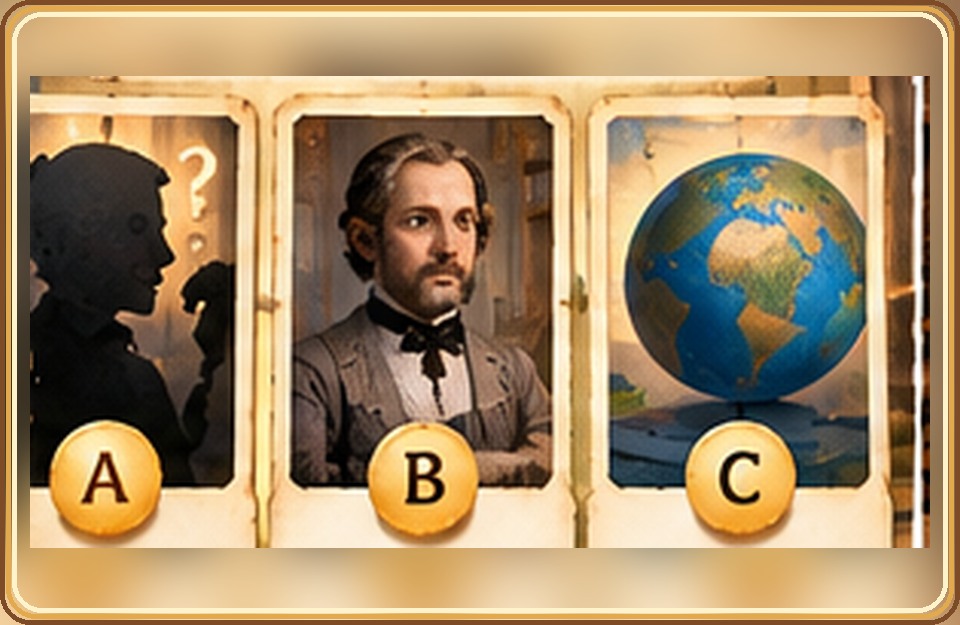
Three bright doors appeared. One led to a clever woman writing notes. Another led to a workshop filled with metal gears. The third showed machines from the present day.
Read slowly. Think carefully. Let your friends hear the last sound.
YOU CHOSE THE WORKSHOP
A Workshop Full of Gears
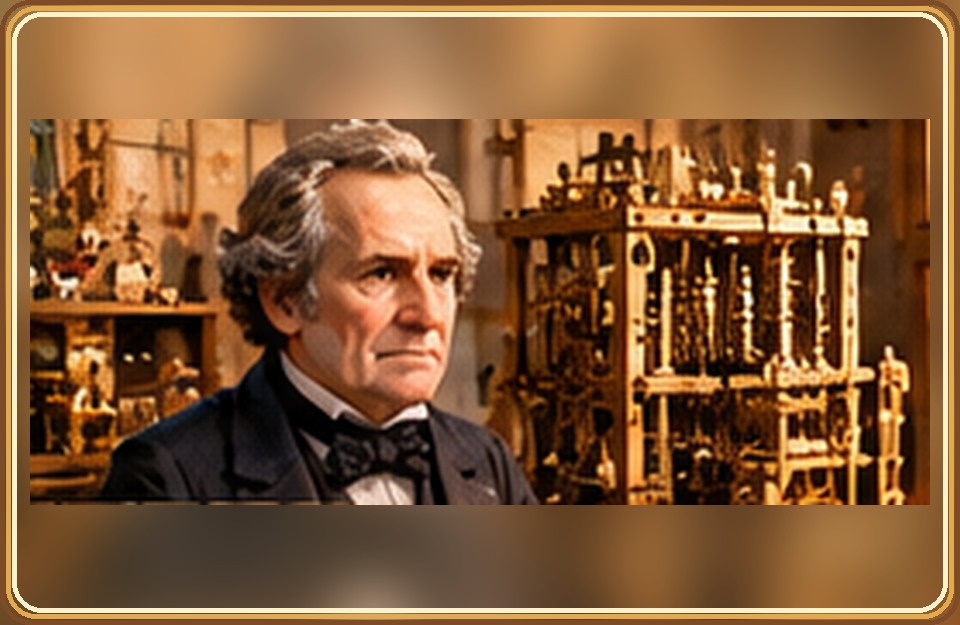
The friends stepped into a busy workshop. Wheels, drawings, and metal gears filled the tables. A man named Charles Babbage was thinking carefully about a machine that could calculate.
“Why make a machine like this?” asked Eevee. “To help people work with numbers,” Ryoto guessed. Babbage smiled at the possibility of machines following carefully planned instructions.
Read slowly. Think carefully. Let your friends hear the last sound.
CHAPTER TWO · LONDON, LONG AGO
Meet Charles Babbage
The golden book carried everyone back to nineteenth-century England. Charles Babbage (1791–1871) was a mathematician and inventor.
He noticed that people sometimes made mistakes during long calculations. He wanted machines to help. He worked on calculating machines, then designed something more ambitious: the Analytical Engine.
Ryoto studied its many gears. “That machine looks complicated!”
TALK AND THINK
Why can machines be helpful with difficult numbers?
Read slowly. Think carefully. Let your friends hear the last sound.
HISTORY CLUE · A DREAM ON PAPER
The Machine That Was a Plan
Babbage worked on plans for the Analytical Engine in the 1830s. It was meant to follow instructions and calculate with numbers. It is an important early design for a programmable computer.
But there was a problem: the complete Analytical Engine was never built in his lifetime. The big idea remained mostly on paper.
“He designed it before people could use it?” Ryoto asked. “Yes,” said Pikachu.
Read slowly. Think carefully. Let your friends hear the last sound.
ANOTHER BRILLIANT THINKER
Meet Ada Lovelace
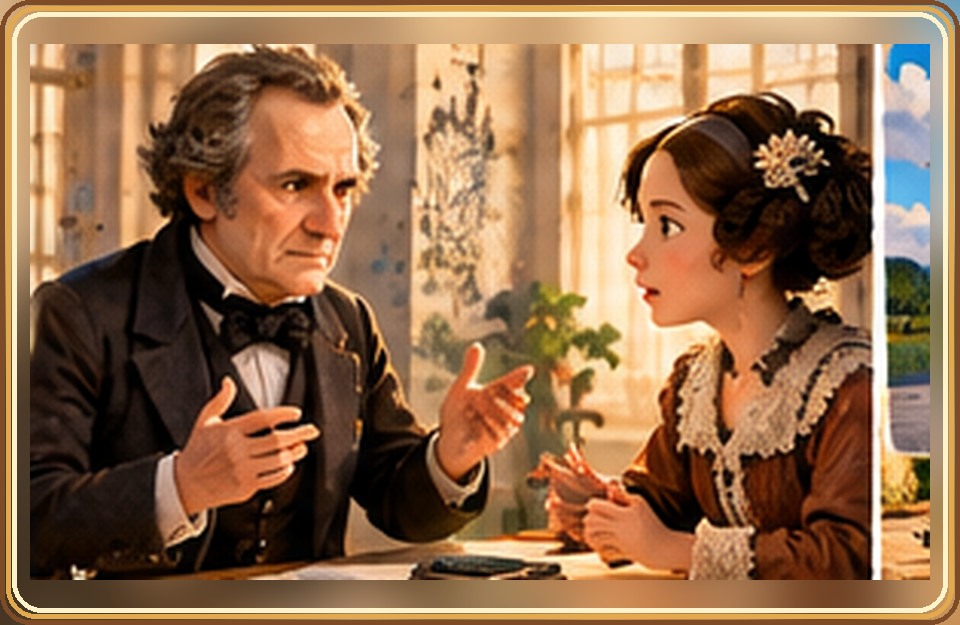
The friends met Ada Lovelace (1815–1852). She was fascinated by mathematics and Babbage’s machine.
In 1843, she published detailed notes about the Analytical Engine. Her notes included a step-by-step method for calculating special numbers. It is often called the first published computer program for a general-purpose machine.
“Instructions can turn a thoughtful plan into something useful,” Pikachu said.
TALK AND THINK
What did Ada publish: a song, a step-by-step plan, or a fairy tale?
Read slowly. Think carefully. Let your friends hear the last sound.
BABBAGE AND LOVELACE
Two Thinkers, One Big Possibility
Babbage designed a remarkable machine. Ada explored the instructions such a machine could follow. Their ideas became part of the long history of computers.
But they were not the only pioneers. Many inventors, mathematicians, engineers, and other thinkers contributed across many years.
“Coding did not appear in one day,” said Pikachu. “People kept asking questions, making plans, testing ideas, and learning.”
Read slowly. Think carefully. Let your friends hear the last sound.
CHAPTER THREE · HOW CODING BEGINS
First Think. Then Give Instructions.
A friendly engineer showed Ryoto a tiny robot. “A computer follows instructions,” she explained. “If the instructions are missing or unclear, it may not do what you want.”
The engineer placed three cards on the desk: START, MOVE FORWARD, and STOP.
“Which card comes first?” she asked. Ryoto arranged the cards in order. The robot followed them. “Excellent! That is a simple algorithm.”
Pick your own path. Explain why your choice matters.
CHOICE TWO · CODING ALL AROUND US
Where Would You Follow Code?
The golden book showed three places where programs help. Each place had a different problem to solve. Ryoto could explore just one before returning to the castle.
Read slowly. Think carefully. Let your friends hear the last sound.
YOU CHOSE TRANSPORT
A Plane Needs Clear Instructions
At the airport, Ryoto saw computers helping people check flight information. Inside a plane, different computer systems help the crew with important tasks.
“The instructions must be tested carefully,” said Raichu. “Safety matters.”
Ryoto realised that coding was not just for games. People could also use programs to help them travel.
TALK AND THINK
Why must instructions for important machines be accurate?
Read slowly. Think carefully. Let your friends hear the last sound.
YOU CHOSE ROBOTS
A Robot Who Waited Patiently
A small robot stood beside a table. It did nothing until the engineer gave it a clear sequence of instructions.
MOVE FORWARD. TURN RIGHT. STOP.
The robot moved along the path. When its instructions changed, it moved in a different way. “It cannot guess what we mean,” Pikachu explained. “We have to be clear.”
TALK AND THINK
Can you guide a toy robot from your chair to the door?
Pick your own path. Explain why your choice matters.
CHOICE THREE · YOUR FIRST BIG IDEA
What Will Ryoto Invent?
The castle offered Ryoto a special chance to plan something new. Three bright invention cards appeared. Pikachu smiled. “You are the inventor! Choose what you want to design.”
Read slowly. Think carefully. Let your friends hear the last sound.
YOU CHOSE THE LOST-PET HELPER
The Kind Robot Cat
Ryoto imagined a friendly robot that could help someone search for a missing pet. The robot would check safe places and show messages to its owner.
Pikachu nodded. “That is a kind idea!”
Ryoto made a simple plan: START. SEARCH SAFELY. REPORT. STOP. A real robot would need many more instructions, but a big idea can begin with a little plan.
TALK AND THINK
How can we be gentle and safe when helping animals?
Read slowly. Think carefully. Let your friends hear the last sound.
THE FIRST CODING PROMISE
Every Program Begins with a Plan
The golden book glowed. Three words appeared: THINK. PLAN. TEST.
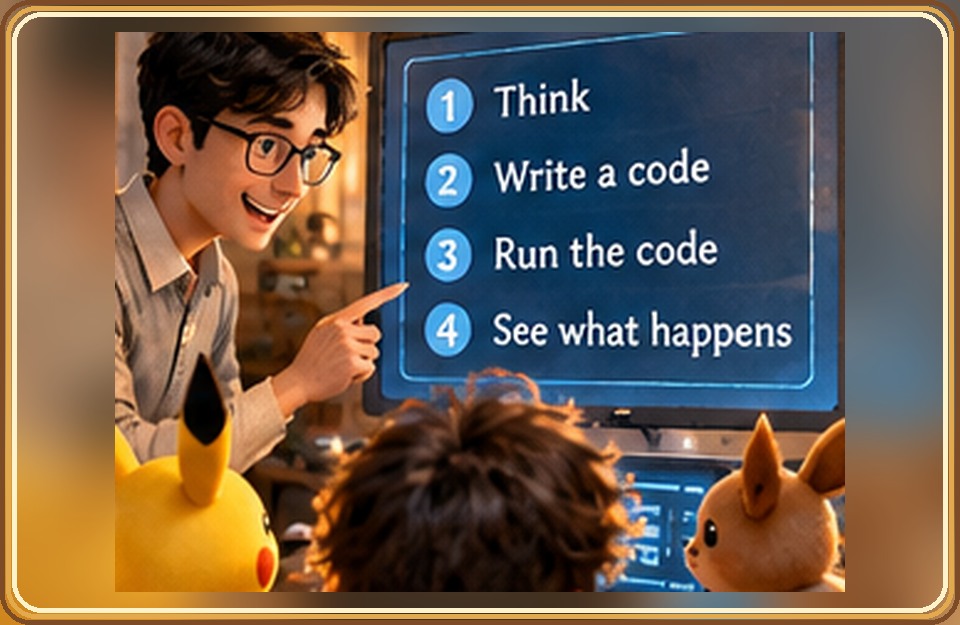
“Before writing computer code, decide what problem you want to solve,” the engineer explained. “Put your instructions in the correct order. Later, test your code and improve it.”
Ryoto smiled. He had not written a computer program yet, but he had planned an algorithm. That was a wonderful beginning.
Read slowly. Think carefully. Let your friends hear the last sound.
THE VALUE OF CURIOSITY
A Brilliant Idea Starts Small
From the castle window, Ryoto watched the sunlight dance over Sydney. He thought about Babbage, who designed a machine, and Ada, who wrote about instructions it could follow.
They asked questions about things that did not exist yet. Other people built on ideas like theirs.
Ryoto realised that he could begin learning too. He needed curiosity, kindness, clear thinking, and practice. He did not have to know everything at once.
TALK AND THINK
What question would you like to ask about computers?
Nobody invented every kind of coding alone. Babbage designed the unbuilt Analytical Engine. In 1843, Ada Lovelace published important notes that included an algorithm for the machine. Many other people helped develop modern computers.
Your brain can do more than pick the answer. Now you get to write it!
WRITE IT YOURSELF. The little word at the right tells you the present-tense verb. Write its past-tense form in the blank. Look carefully at double letters and spelling changes.
Listen to the last sound. Sort the words like a pronunciation detective.
THE SECRET: Regular -ed verbs use three ending sounds: /t/, /d/, and /ɪd/. It depends on the final sound of the original verb, not the last letter. Choose a word, then choose a sound bucket.
Twelve little action words. One crisp ending sound.
HEAR • SAY • READ. After a quiet (voiceless) final sound other than /t/, the -ed ending usually sounds like /t/. Do not add another syllable. Select Hear word, repeat slowly, and read its sentence to your teacher. Your teacher listens for the final sound. No voice is recorded or automatically graded.
Keep your voice on at the end and make the /d/ small but clear.
HEAR • SAY • READ. After a voiced final sound other than /d/, the -ed ending usually sounds like /d/. Do not add another syllable. Select Hear word, repeat slowly, and read its sentence to your teacher. Your teacher listens for the final sound. No voice is recorded or automatically graded.
These words have one more syllable. Clap and say them slowly.
HEAR • SAY • READ. After a base verb ending in /t/ or /d/, add a small extra syllable: /ɪd/. Clap the two or three syllables. Select Hear word, repeat slowly, and read its sentence to your teacher. Your teacher listens for the final sound. No voice is recorded or automatically graded.
Can you read these words slowly, with a strong little ending sound?
LISTEN, SAY, DECIDE. Read the word aloud. Choose the ending sound you hear yourself saying. Press Hear to listen to a model voice. Your teacher will check your pronunciation.
Great work! A little practice each time helps you become a stronger reader and a clever problem-solver.
What Ryoto can do now
I can explain what coding is. I know that Charles Babbage designed the Analytical Engine and Ada Lovelace published a famous set of instructions for it.
I can choose a word to complete a sentence, write past-tense words, and hear the difference between /t/, /d/, and /ɪd/.
Read this little story aloud
Ryoto opened the golden book. Pikachu jumped and smiled. Eevee waited by the door. The friends looked for clues. They helped each other and started a new adventure.